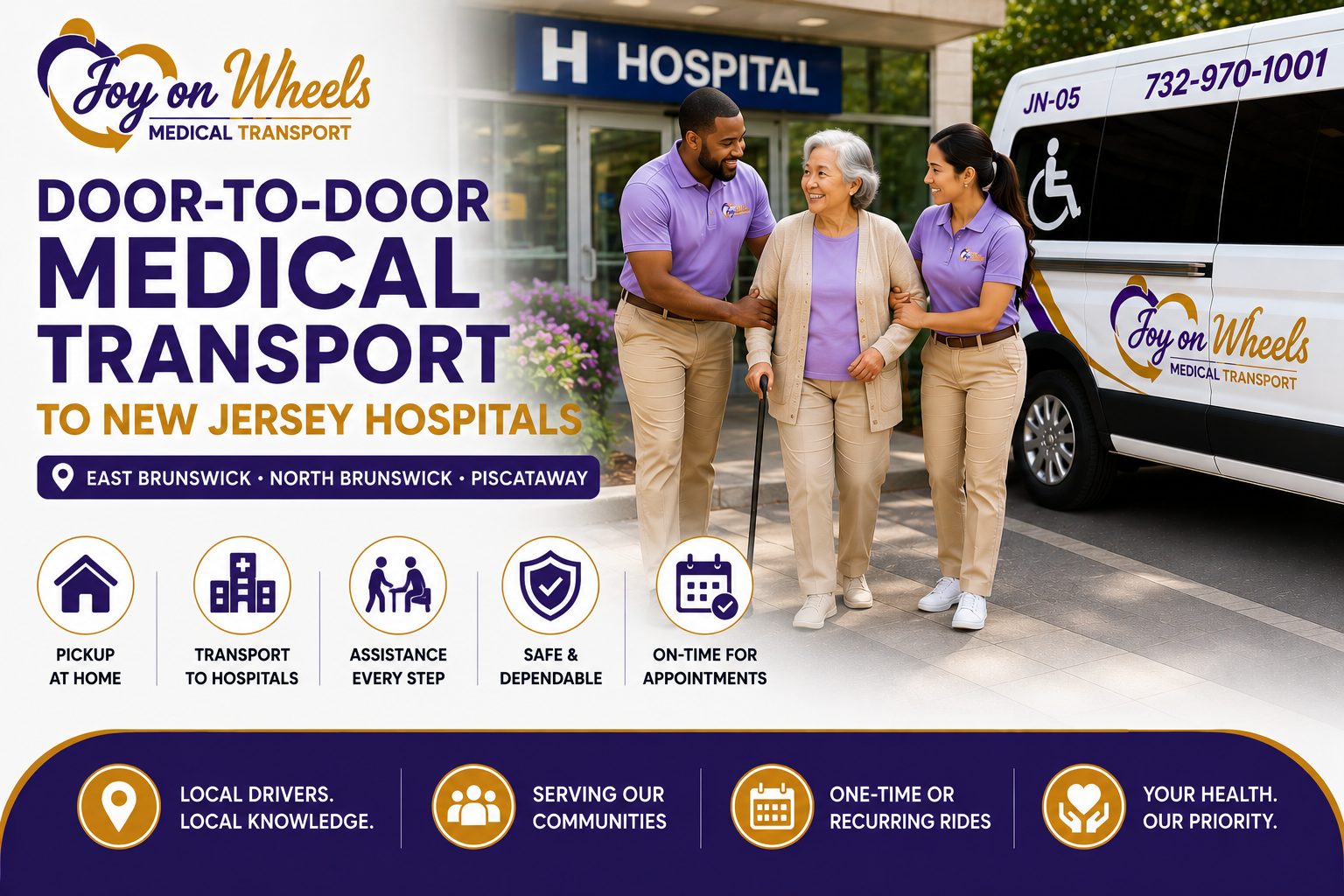
Yes—if you or a loved one can no longer drive safely, cannot comfortably use public transportation, or needs reliable assistance getting from home to a hospital or medical appointment, door-to-door medical transport can be an excellent non-emergency option. For seniors and patients in East Brunswick, North Brunswick, and Piscataway travelling to hospitals in New Brunswick and throughout New Jersey, professional ambulatory or wheelchair transportation can provide a safer, more dependable journey than relying on family members or ordinary rideshare services.
Medical appointments do not always happen close to home. A patient living in East Brunswick may need to travel to a hospital in New Brunswick. Someone in North Brunswick may need to see a specialist in Edison, Princeton, or another New Jersey community. A senior in Piscataway may need recurring transportation for dialysis, rehabilitation, or outpatient treatment.
The right transportation service can make that journey easier to plan.
Door-to-door medical transport is a non-emergency transportation service designed to take a passenger from a specific pickup location to a healthcare destination.
Depending on the service and the passenger’s mobility needs, the trip may include:
For example, a senior living near Route 18 in East Brunswick may need transportation to a hospital in New Brunswick. Rather than asking a family member to take time off work, navigate hospital parking, and coordinate the return journey, the family may arrange professional non-emergency medical transportation.
The exact level of assistance depends on the passenger’s mobility needs and the provider’s service policies.
Ambulatory transportation is non-emergency medical transportation for passengers who can walk independently or with limited assistance.
A person using a cane or walker may still be considered ambulatory if they can safely enter and exit a vehicle.
Ambulatory transportation may be appropriate for someone who:
For example, a senior in North Brunswick may be able to walk from their front door to a vehicle but may not be comfortable driving to a hospital appointment in New Brunswick.
That is an example of where ambulatory medical transportation may be appropriate.
The answer depends on the passenger’s physical condition and transportation requirements.
Generally, a passenger may be suitable for ambulatory transportation if they can:
New Jersey transportation rules distinguish transportation needs based on the passenger’s mobility and medical requirements. Patients who can use lower levels of transportation may not need wheelchair or ambulance transportation, while others may require a higher level of assistance. (law.cornell.edu)
If a family is uncertain about the correct transportation type, they should explain the passenger’s condition clearly to the transportation provider and, when appropriate, consult the passenger’s healthcare professional.
One of the most important decisions is choosing the correct type of transportation.
Ambulatory Transportation | Wheelchair Transportation |
Passenger can walk to the vehicle | Passenger may need to remain in a wheelchair |
May use a cane or walker | Requires accessible lift or ramp equipment |
Passenger usually sits in a vehicle seat | Passenger may remain secured in a wheelchair |
Suitable for passengers with greater mobility | Suitable for passengers unable to safely transfer |
Imagine two patients:
Patient A: A senior in East Brunswick uses a cane but can walk independently. They need transportation to a hospital in New Brunswick.
Patient B: A patient in Piscataway cannot safely transfer from their wheelchair into a vehicle seat.
Patient A may be appropriate for ambulatory transportation. Patient B may require wheelchair transportation.
The right answer depends on the passenger—not simply their age or diagnosis.
Yes. Many elderly patients can travel safely without an ambulance when they are medically stable and do not require emergency treatment or ambulance-level medical monitoring.
Non-emergency transportation may be appropriate for:
However, a non-emergency medical vehicle is not a replacement for emergency services.
If someone has severe chest pain, serious breathing difficulty, sudden confusion, a major injury, or another potentially life-threatening emergency, call emergency services instead of arranging ordinary medical transportation.
The purpose of non-emergency transportation is to provide reliable access to scheduled healthcare—not emergency treatment.
For an appropriate passenger, professional ambulatory transportation can be a safer and more comfortable option than driving alone or attempting to use public transportation.
Safety depends on several factors:
A common mistake is assuming that every senior should use an ambulance simply because they are elderly.
Another common mistake is assuming that a standard taxi or rideshare vehicle is suitable for every medical transportation situation.
For example, a senior in Piscataway may be physically able to walk but may struggle with long distances, winter weather, unfamiliar hospital parking, or navigating a large healthcare campus.
A professional transportation service can provide a more predictable travel experience.
Many families ask, how much does ambulatory transport cost in Essex County?
There is no single price for every trip because transportation costs may depend on:
A short trip within Newark, Bloomfield, or Montclair may have different pricing from a longer journey connecting Essex County with Middlesex County.
Before booking, ask:
A professional provider should explain the transportation arrangement clearly before the trip is confirmed.
Coverage depends on the passenger’s insurance plan and eligibility.
For eligible NJ FamilyCare members, New Jersey Medicaid provides non-emergency medical transportation for eligible individuals travelling to medically necessary, covered services. Transportation arrangements require information such as the pickup location, healthcare provider, appointment details, and special transportation needs.
Private insurance coverage varies.
If you are asking, is ambulatory transport covered by insurance?, do not assume that the answer is automatically yes.
Ask the insurance provider:
Many families ask, can Medicare pay for ambulatory transport?
Original Medicare’s ambulance benefit generally applies to medically necessary ambulance transportation when other forms of transportation could endanger the patient’s health and specific requirements are met. Routine ambulatory transportation is not automatically covered simply because the passenger is elderly or travelling to a medical appointment. (medicare.gov)
Medicare Advantage plans may have different benefits, so passengers should review their specific plan documents or contact the plan directly.
If you need to arrange transportation from East Brunswick, North Brunswick, or Piscataway, having complete information ready can make the booking process easier.
Include:
This may be:
Tell the provider whether the passenger:
Share:
Do not forget to discuss how the passenger will return home.
This is particularly important when appointments may run late or when a patient does not know exactly when they will be ready to leave.
Arrival time depends on:
A trip from East Brunswick to New Brunswick may be easier to coordinate in advance than a last-minute request during a busy weekday morning.
For routine medical appointments, booking ahead is recommended.
For eligible NJ FamilyCare members, New Jersey provides specific procedures for arranging non-emergency medical transportation and recommends planning.
The answer to what vehicles are used for ambulatory transport depends on the provider and the passenger’s needs.
Common vehicles may include:
A passenger who walks independently may be able to use a standard passenger vehicle, while someone using a walker may require additional space and easier vehicle access.
Always tell the provider about:
Accurate information helps the provider determine the most suitable transportation option.
Central New Jersey residents frequently travel between communities for medical care.
A resident near East Brunswick’s Route 18 corridor may need transportation to a hospital or specialist in New Brunswick.
The trip may appear short on a map, but hospital traffic, parking, and appointment schedules can make the journey stressful for an older adult.
Patients from North Brunswick may need transportation to medical facilities in New Brunswick, Edison, Princeton, or other nearby communities.
A professional service can help families coordinate the trip around the appointment time.
A senior from Piscataway may need transportation to a hospital, specialist, or outpatient facility in New Brunswick.
For someone who does not drive, the journey may involve multiple public transportation connections or long walking distances—especially during winter or severe weather.
Routes such as Route 1, Route 18, Route 27, and the New Jersey Turnpike can become busy during peak travel periods.
Snow and ice can make walking to a bus stop or waiting outside particularly difficult for seniors.
Older adults may also struggle with extended outdoor waiting during hot and humid New Jersey summers.
Hospitals may have multiple entrances and departments. A passenger unfamiliar with the campus may need clear instructions regarding the correct drop-off location.
Medical appointments do not always finish at the scheduled time. Families should discuss return transportation and waiting arrangements in advance.
A family may assume they can arrange transportation a few hours before an appointment. Availability may be limited.
Saying “the patient can walk” may not be enough. The provider should know whether the passenger uses a walker, has difficulty with stairs, or needs assistance.
A passenger who cannot safely transfer may need wheelchair transportation rather than ambulatory transportation.
Always discuss whether return transportation is required.
Many hospitals may provide discharge planning resources or transportation information, but families should not assume that every hospital provides private door-to-door medical transportation for every appointment.
The answer depends on the hospital.
Some hospitals may:
However, hospitals do not necessarily provide private door-to-door transportation for every routine outpatient appointment.
Patients should ask the hospital’s social work, discharge planning, or patient services department what transportation assistance may be available.
For scheduled transportation from East Brunswick, North Brunswick, or Piscataway, arranging a professional transportation provider in advance may provide greater certainty.
There is no universal distance limit for every private transportation provider.
A trip may be:
The provider’s service area, schedule, vehicle availability, and passenger needs determine whether a particular trip can be accommodated.
Long-distance transportation should generally be arranged as early as possible.
Families often ask, is ambulatory transport available 24 hours in Camden County?
The answer depends on the transportation company’s operating hours and availability.
Some providers may offer extended-hours or scheduled after-hours transportation, while others may operate only during specific business hours.
Before booking an overnight or early-morning trip, ask:
Never assume that every medical transportation company provides 24-hour transportation.
Medical transportation needs often cross municipal and county boundaries.
Depending on the provider’s service area, common nearby communities may include:
Service availability should always be confirmed for the exact pickup address and destination.
You should consider calling a professional non-emergency medical transportation provider when:
A professional transportation provider can help discuss whether ambulatory transportation, wheelchair transportation, or another service is most appropriate.
Joy On Wheels Medical Transportation is a family-owned and operated transportation business serving New Jersey communities.
The company’s mission is focused on helping people maintain access to healthcare, independence, and important daily activities through dependable transportation. Its service approach is designed around compassionate care and reliable travel for patients and families.
For passengers in East Brunswick, North Brunswick, Piscataway, New Brunswick, and surrounding areas, important factors when choosing a transportation provider include:
Before booking, families should clearly explain the passenger’s mobility requirements and the complete trip details.
If you need transportation from East Brunswick, North Brunswick, or Piscataway to a New Jersey hospital or medical appointment, planning can make the journey easier and less stressful.
Whether you need transportation to a hospital in New Brunswick, a specialist in Edison, a rehabilitation facility in Somerset County, or another medical destination, a professional transportation provider can help you discuss the passenger’s needs and scheduling requirements.
Door-to-door medical transport takes a passenger from a specific home or residence in East Brunswick to a hospital or medical appointment in New Brunswick, with the exact assistance depending on the passenger’s mobility needs.
Passengers who can safely sit in a vehicle and walk independently or with limited assistance may be suitable for ambulatory transportation, depending on their individual needs.
Ambulatory transportation can be a safe option for seniors when the passenger’s mobility is suitable for the service and the provider receives accurate information about their transportation needs.
Yes, medically stable elderly patients who do not require emergency care or ambulance-level monitoring may be able to travel to scheduled hospital appointments using non-emergency medical transportation.
Arrival time depends on driver availability, vehicle availability, distance, traffic, and whether the trip was scheduled in advance.
Medicare does not automatically cover routine ambulatory transportation, so passengers should review their specific Medicare or Medicare Advantage benefits before booking.
Some hospitals may provide transportation information or discharge-planning assistance, but patients should not assume that every hospital provides private door-to-door ambulatory transportation for routine appointments.